Does God appoint some for salvation and not others? An examination of Acts 13:48

Saturday, April 18, 2009

Steve!

R. here. My wife and I are studying the Bible with a young couple, and J. has been heavily influenced by Calvinism. Predestination, Total Depravity, Irresistible Grace -- the whole nine yards. His weak points are his children. It bothers him that one of them might be predestined to be lost. You get the idea. If you have any words of wisdom or insight I am your eager student (again). I love your website. It looks good and keep up the good work.

Take care, R.

R., thanks for the update. I just have a minute, but I think I may be able to help you. On DeeperStudy.com, on my systematic theology page, and some study material on Calvinism (which I label "Reformed Theology").

Many of my other links on the Systematic Theology page are from reformed writers, probably because of their tremendous respect for the authority of the Word of God. But on the T-U-L-I-P- part, I just can't reconcile it with Scripture. Look especially at the "Weighed & Found Wanting" article.

I think you should be asking yourself, what is the common ground I can find with what they are saying? Each of the points has an important truth that it would have contributed if it hadn't taken it too far. Focus on that truth and show how the Calvinist teaching went beyond what the Bible really says on the subject. Example: Irresistible Grace, see John 6:44--God draws us through the winsome message of the gospel, though not irresistibly.

I would be happy to dialogue with you as you work your way through this material.

Look also at the available books, especially the two views book. The first one listed, by Hanko, et al., is pro-Calvinist.

Steve,

Thank you for the input. I have just done considerable reading this evening since getting home from our study. He actually wants to put off further discussions on this till a little bit later. However, I have a question about Acts 13:48. This was the passage brought up last week. I studied the Greek a little bit from a few commentaries but could you give me some of your input on this passage?

Thanks, R.

(Actually Tyndale commentary was pretty good on this, as was Alexander Campbell.)

Stange. I read Acts 13 this week and was already thinking about "As many as were in the state of having been appointed unto eternal life believed." (That is a literal rendering of the periphrastic construction of "was" combined with a perfect participle.)

How can we reconcile these passage, which certainly seems to imply predestination and irresistible grace, with the "whosoever" passages like Mark 16:16, John 3:16, and others, as well as passages that clearly say Jesus died for all, not just some, and that God's desire is for all to experience salvation (e.g., 1 John 2:2, 1 Timothy 2:4-5, and 2 Peter 3:9)? One way to harmonize them is to use the analogy of invitations to a class party. All the members of the class are invited, but only a few attend.

Yet we can say that only the invited are at the party without saying those to didn't come weren't invited. Am I talking in circles or guilty of sophistry? I hope not.

Those who responded to Paul's preaching "believed" (in the comprehensive sense of responded to the gospel, for everything involved in responding is prompted by faith in Christ and inspired by His most excellent sacrifice and power to redeem). By "believing," they were demonstrating that God included even them in the invitation.

Keep in mind that this is before the Jerusalem conference in which Paul's "way-out-there," radical teaching of accepting Gentiles as legitimate Christians without demanding that they be circumcised was confirmed by the apostles and elders of the Jerusalem mother-church. Why did the conference make this decision? Because they had substantial proof that it was God's will. What was the proof?

1) Peter's testimony about the conversion of Cornelius and his household, which involved a number of guiding and confirming miracles, as well as the willingness of Cornelius and the others to respond to the gospel.

2) The testimony of Paul and Barnabas about the success of their missionary journey, in which they consistently pursued this policy with regard to the Gentiles. Not only did God empower them to work miracles, something He would not have done if they had been misleading their converts, but He also blessed them with many responsive hearts. In other words, if at the conference they had been forced to admit that their preaching of salvation based on grace through faith met with an icy reception, the brothers in Jerusalem might have relegated the entire discussion to a matter of hypotheticals. But the Gentiles gladly accepted the message of salvation, which demonstrates that God wanted them to be saved, and we can even say "appointed them for eternal life."

The use of the perfect participle suggests that this was a long-standing appointment, as far as God was concerned. That takes us back into the Old Testament to such passages as Isaiah 49:6 (which Paul quotes to the disaffected Jews just before our target verse, see Acts 13:47), and many others, leading all the way back to the "fountainhead," Gen. 12:3. It had been God's intention for Israel to lead the Gentiles to salvation, and when they failed (see Isa. 26:18 and 52:5), God was determined to bring salvation to the Gentiles anyway, through the Messiah (see Isa. 59:1-20). No one else would do it, so He had to do it Himself.

He had appointed the Gentiles for eternal life. So when they heard the gospel, it was possible for them to respond to it, even though they weren't Jews. The forgiveness and salvation Paul offered them was a bonafide offer from God. Their openness to the message was a demonstration that God had a hand in their conversion. But His work was not an election (of some and not others), followed by an irresistible calling of that "chosen few." His work was the gospel "God's power unto salvation to everyone who believes, first to the Jew and also to the Greek" (Romans 1:16).

Response? How does this compare with the other things you read? Also, is it OK, if I put this on my blog?

Steve

Steve, Amen! Put it on the blog! I'm loving it! At first I wasn't sure where you were going (actually in the middle) but you developed the concept extremely well and then brought in the OT passages about God having this in mind from the beginning. With everything put in context it is the best argument I have read.

Actually Tyndale went into the Greek word for appointed and brought up an alternate understanding. That the term can be used (and has, I guess) as a military term meaning "To be set in place," i.e., as a military general would set his troups in place for a certain position in the battle line for instance. The meaning would then take on the idea that the Gentiles by receiving and glorifying the Word of the Lord with joy, they were 'set in place' (a.k.a. ‘appointed’) to receive eternal life. Tyndale makes their action of joyfully receiving the Word a deciding factor that sets them in place for salvation. I may be drawing too much out of his argument but that seems to be the gist of it. I did not do a Greek study to confirm this rather unexpected tack. Anyway, I am going to print off and study your full argument and study it.

Thank you, Steve.

R.

Want to Go Deeper?

Consider the following passages regarding whether individuals are predestined for salvation or for destruction. Our goal is not to pick passages that teach what we want to truth to be and ignore passages that seem to conflict with them, but to go deeper and seek a way to reconcile and harmonize them all without doing violence to the context of each passage.

  • John 3:16 – The "whoever" or "whosoever" of this famous verse leads us to believe that salvation in Christ is available to everyone who responds to it, not just a select group.
  • Mark 16:16 – "Whosoever" in this text is as wide as the "all creation" of the previous verse. The risen Lord places no limitation of who could respond to the gospel proclamation. Other "whosoever" texts to consider include: Mark 3:35 (parallel: Matthew 12:50); Mark 8:34-35 (par. Matthew 16:25; Luke 17:33); Mark 9:37 (par. Matthew 18:4); Mark 9:41; Matthew 13:12; Luke 6:47; 7:23; 8:35; John 11:26; 12:46; Acts 2:21 (quoting Joel 2:32); Romans 9:33 and 10:11 (both quoting Isa. 28:16); 1 John 4:15; and Revelation 22:17.
  • Mark 13:20, 22, 27 (parallels: Matthew 24:22, 24, 31); Luke 18:7 – Jesus calls his followers "the elect," which means the Chosen Ones. This theme of election recurs in the epistles: study Romans 8:33; Colossians 3:12; 1 Thessalonians 1:4; 2 Timothy 2:10; Titus 1:1; 1 Peter 1:2, 6; 2 Peter 1:10. Does this mean that those who don't respond aren't "the chosen"? Who does the choosing, God or we? He has chosen HOW, not WHO.
  • An important cluster of elections verses occurs in Romans 9 - 11, dealing with God's choice of Israel: Rom. 9:11 and Romans 11:5, 7, 28.
For online reading:

F. Furman Kearley. "The Biblical Doctrine of Predestination, Foreordination, and Election". – Kearley was one of my mentors and an excellent biblical scholar. His take on Acts 13:48 is similar to the Tyndale commentary.

Recommended for purchase:
Robert Shank. Elect in the Son: The Biblical Doctrine of Election. Westcott, 1970; Reprint: Baker, 1989. – This is a thorough study of election throughout the Bible, treating every passage in its context. Shank studied his way out of Calvinism and shares with us what he discovered.

In the last few years, more and more books have appeared discussing crucial biblical doctrines from different points of view. Here are some helpful books if you want to consider the arguments on both sides regarding election:

Dave Hunt & James White. Debating Calvinism: Five Points, Two Views (Multnomah, 2004).

Robert A. Peterson & Michael D. Williams. Why I am Not an Arminian (InterVarsity, 2004).

Jerry L. Walls & Joseph R. Dongell. Why I am Not a Calvinist (InterVarsity, 2004).

Steve Singleton, DeeperStudy.com
Subscribe to feed

Labels: , ,

G-Harmony: Just who--or what--are you looking for?

Monday, January 12, 2009

Seeking that Special Someone?
Are you looking for a special relationship with the Divine Being but are not sure where to find it or if having such a relationship is even possible? Well, then, G-Harmony is for you! You can be confident that God is eagerly seeking a relationship with you as well.

Just answer this simple, five-question survey, and you are well on your way to experiencing the spiritual relationship you have longed for.

G-Harmony Questionnaire

  1. How easily can you admit that you were wrong and need forgiveness, and are you willing to accept forgiveness when it is offered?

  2. Is it easy or difficult for you to receive guidance regarding how to improve your life, enhance the effectiveness of your actions, and make your thinking more positive?

  3. Are you willing to be flexible regarding your budget, your work habits, and your schedule?

  4. Are you willing to try new things, go new places, and meet new people?

  5. How willing are you to get involved in the lives of people around you?

About Question 1
God has found that many people either have a hard time admitting they have sinned or feel so overwhelmed that they can't conceive of the possibility of forgiveness. Both are self-centered responses. One of the first gifts God offers you is Grace--His willingness to forgive you through the sacrifice of Jesus, despite what you have done wrong. But if you want to save yourself or sense no need to be forgiven, then God can't help you (Luke 5:31-32).

All He asks is that you trust Him and allow Him to do for you what you are incapable of doing for yourself. He calls this saving experience "the new birth" or identifying with the death, burial, and resurrection of Jesus Christ (John 3:3-5; Rom. 6:1-7; Col. 2:12-13; Titus 3:5). He wants to make you one with Him, or "in Christ" (Romans 8:1-2).

About Questions 2 - 5
The other four questions turn from Jesus as Savior to Jesus as Lord. A transformed life is possible, but only because God empowers you through His Holy Spirit as a response to your willingness to change (2 Corinthians 3:17-18). God has established a support network called Christ's church to make it easier for you to move from worthless to worthy (Galatians 6:1-5). He makes everyone in genuine relationship with Him a part of this support network (1 Corinthians 12:12-27; Ephesians 1:18-23).

Some aspects of your new relationship you will immediately find deeply satisfying, such as receiving from God a profound sense of value and acceptance (Galatians 2:20; Ephesians 1:3-8). Other aspects may cause you concern, at least at first, such as His firm demand that you participate in his program for your continuous improvement (Philippians 3:10-16) and His insistence that you connect with those around you (Romans 12:9-13).

You will discover that these requirements, though they be unsettling at first, are in fact, some of the most endearing parts of the relationship.

G-Harmony Caveat
I need to say up front: God is seeking a long-term relationship. There's no guarantee that if you back out, you can regain your former self-centered personality or life-style, at least not right away. These things take time.

Want to Go Deeper?


Here are some of the major biblical passages about the husband-wife metaphor describing God's bittersweet love-relationship with human beings:

  • Song of Solomon – An old tradition applies this celebration of married love to God and Israel (Jewish version) or Christ and the church (Christian version). The entire approach is questionable as probably not part of the original author's intent, but many hymns draw imagery from this source, e.g. "Lilly of the valley," "I'm my beloved's and He is mine," and "His banner over us is love."

  • Isaiah 50:1 – God divorces His people because of her sins.

  • Hosea, chapters 1 through 3 – The prophet's compassion for his adulterous wife corresponds to God's love for His people.

  • Ezekiel, chapters 16 and 23 – Israel's unfaithfulness to God is told as allegories of an adulterous wife.

  • John 3:25-30 – John the Baptizer sees his purpose as ensuring that Jesus and Israel consummate their union.

  • Matthew 22:1-14 and 25:1-13 – Christ's first and second comings are both pictured as a man getting married.

  • Ephesians 5:22-32 – Christ's faithful love for His wife, the church and its benefits to her.

  • 2 Corinthians 11:2-3 – Paul says he presented the Corinthians to Christ as a pure virgin to her husband.

  • Revelation 19:6-9; 21:2-5 – Christ, the One who is "faithful and true," receives His bride, pictured as "the New Jerusalem" and identified as "His holy ones."

Recommended for purchase (at discount)

Gene Edwards. The Divine Romance Tyndale, 1993. – Combines the simplicity of storytelling art with the profound depths of the Christian faith. This sweeping saga spans from eternity to eternity, revealing some of the deepest riches afforded the believer. Like a mighty symphony, here is a majestic rendition of the love of God. The story concludes at the consummation of the ages, when a victorious Lord takes his bride to himself. Truly the greatest love story ever told.

James Bryan Smith. Embracing the Love of God: The Path & Promise of the Christian Life. HarperOne, 2008. – Let God's immense love for you sink into your heart and soul like never before! These days when it seems many Christians are overcome with activities and trying to please people, their faith often becomes legalism. The only way to stop the cycle is to let God's love and approval embrace you, now and every day. Banish feelings of fear and insignificance, and develop a lifestyle of love and acceptance.

Recommended for online reading

John H. A. Ebrard. Commentary on 1 John 3:1-3 from his Biblical Commentary on the Epistles of St John. Trans. W. B. Pope. Edinburgh: T.&T. Clark, 1860.

G. G. Findlay. "Christ and His Bride", pp. 91-95 in his The Epistle to the Ephesians from An Exposition of the Bible, ed. by Marcus Dods, et al. Hartford, CT: S. S. Scranton, 1903. – Exposition of Ephesians 5:22-32.

Steve Singleton, DeeperStudy.com
Subscribe to feed

Labels: , , ,

Is questioning a so-called prophet blaspheming against the Holy Spirit?

Friday, December 05, 2008

Q. What is the "blasphemy against the Holy Spirit"? Why is it called an unforgivable sin? Is there any way for a person to commit this sin today? Is the person who questions a self-appointed prophet guilty of committing this sin?

Jesus taught about the blasphemy against the Holy Spirit as recorded in Mark 3:20-30 and the parallel passages in Matthew 12:25-32, Luke 11:14-20, and 12:8-10. The people were amazed that Jesus had the power to exorcize demons, but the teachers of the law claimed that he was possessed by Beelzebub himself and that He cast them out by the power of "the prince of demons."

After making several arguments against this claim, Jesus said:

I tell you the truth, all the sins and blasphemies of men will be forgiven them. But whoever blasphemes against the Holy Spirit will never be forgiven; he is guilty of an eternal sin. --Mark 3:28-29

Mark then adds, "He said this because they were saying, 'He has an evil spirit.'" (v. 30).

The miraculous power Jesus demonstrated was from the Holy Spirit. Here's how the Apostle Peter explains it:

God anointed Jesus of Nazareth with the Holy Spirit and power, and... he went around doing good and healing all who were under the power of the devil, because God was with him. --Acts 10:38

The Holy Spirit used the miraculous powers He gave to Jesus as a means of testifying to His divine nature. He authenticated the words of Jesus as having come from God. That's what the anonymous author of Hebrews says:

This salvation, which was first announced by the Lord, was confirmed to us by those who heard him. God also testified to it by signs, wonders, and various miracles, and gifts of the Holy Spirit distributed according to his will. --Hebrews 2:3-4

In other words, the very signs God provided to validate Jesus the Jewish leaders acknowledged as genuine, but they denied the power was from the Holy Spirit, opting instead for a diabolical source. This Jesus will not tolerate. This, he says, God cannot forgive.

The short answer to the question about why this sin is unforgivable, is simply, because Jesus said it was. The person on whom all forgiveness depends is sovereign over sin and over its forgiveness. Jesus takes this offense personally. His eternal, intimate love-bond with the Holy Spirit is at stake. The Spirit is selfless, always pointing to Jesus and lifting Him up. For someone to see the signs and acknowledge their power, yet deny their obvious origin is to insult the Spirit and slander his very character.

Why did the Jewish leaders take this stand? It was because Jesus refused to conform to their preconceptions of what the Messiah would be like and to their traditional way of interpreting the law of Moses. Rather than admit they might be wrong about one or the other or both, they concluded Jesus must be wrong, and therefore His obvious power must be from Satan, not from the "Giver of every good and perfect gift."

Denying or explaining away the very signs that should have prompted faith to grow in their hearts, they turned their backs on their only hope for deliverance.

This volley of rejection against Jesus and the Spirit continued. Later rabbinic writings refer to Jesus as Balaam, the prophet whom the Moabite king hired to curse Israel (Numbers 22 - 24). Try as he did, Balaam could only bless the Israelites. To compare Jesus to Balaam continues the blasphemy of the first century through later generations.

Is it possible to commit this same sin today? Certainly, though people who want to reject Jesus seldom take that approach. Rather than acknowledging his power but explaining it as diabolical, they either deny the historicity of the gospel accounts, or they attempt some rationalistic explanation of his miracles. Often these attempts are made with a self-satisfied pomposity that congratulates its own intellectual elitism: "Of course, no one believes that those poor people were really possessed by the boogy-man. Either they had epilepsy or some form of mental illness." "People were so gullible and superstitious back then. I'm amazed that they could accept at face value a young girl's claim about the Holy Spirit getting her pregnant or that what happened to an even younger girl behind closed doors was a resurrection instead of a fever breaking."

Such a response to the Good News is wrong--it is certainly damning--but it is not unforgivable. It is simply arrogant and closed-minded.

Some would apply the warning about blaspheming against the Spirit to any would would seek to debunk self-appointed prophets, modern-day tongues-speakers, and faith healers. While we should all examine our own hearts and ensure that our motives are pure, a number of passages urge us to put prophecy to the test, and by extension, the same would apply to the other claims of miraculous gifts.

Here's a sampling of such passages, listed in chronological order:

  • 1 Thessalonians 5:19-22 – Do not put out the Spirit's fire; do not treat prophecies with contempt. Test everything. Hold on to the good. Avoid every kind of evil. Paul is addressing a problem that arose quite early. Some were treating prophecies with contempt. Paul said this should not be done, but neither does he say everything that passes as prophecy should be automatically accepted as such. It all must be put to the test: what passes should be accepted, and what fails should be rejected.


  • 2 Corinthians 12:11-12 – I am not in the least inferior to the "super-apostles," even though I am nothing. The things that mark an apostle--signs, wonders, and miracles--were done among you with great perseverance. Paul is willing for his own powers to be tested, confident that he will pass the test.


  • Ephesians 4:14-15 – Then we will no longer be infants, tossed back and forth by the waves and blown here and there by the cunning and craftiness of men in their deceitful scheming. Instead, speaking the truth in love, we will in all things grow up into him who is the Head, that is, Christ. – Paul realizes how credulous his fellow Christians are, and he looks forward to the time when they will be more mature, undeceived by charlatans.


  • 1 John 4:1 – Dear friends, do not believer every spirit, but test the spirits to see whether they are from God, because many false prophets have gone out into the world. – After this solemn warning, the apostle immediately gives a doctrinal test to determine who is a legitimate prophet. This is similar to the warnings Moses and Jesus himself delivered (see Deuteronomy 13:1-5; 18:20-22; and Matthew 7:15-23).

In a future blog, I hope to show how we can test modern prophets, tongues-speakers, and faith healers.

Want to Go Deeper?

Recommended for purchase (at discount)

Graham H. Twelftree. In the Name of Jesus: Exorcism Among Early Christians Baker, 2007. 352 pp. – Can evil spirits invade and control individuals---and be expelled? For many biblical scholars, says Twelftree, this is akin to believing in "elves, dragons, or a flat earth." But for Christians worldwide, especially in developing countries, exorcism unlocks the bonds of spiritual captivity. A reliable and historical discussion of exorcism within the early church.

Todd Klutz. The Exorcism Stories in Luke-Acts: A Sociostylistic Reading. Cambridge University, 2004. 314 pp. – Integrates detailed, literary criticism of the exorcism stories in Luke-Acts with wide-ranging comparative study of ancient sources on demonology, spirit affliction and exorcistic healing. Explores the implied author's relationship with Judaism in relation to the stories' original context of reception. Probes largely neglected interfaces between Luke's representation of exorcism and emerging academic discourse about religious experience, shamanism, health care in antiquity, ritual performance and ancient Jewish systems of impurity to shed fresh light on this supremely alien part of the Lukan writings.

Stanley N. Gundry and Wayne A. Grudem. Are Miraculous Gifts for Today? Four Views. Zondervan, 1996. – Are the gifts of tongues, prophecy, and healing for today? No, say cessationists. Yes, say Pentecostal and Third Wave Christians. Maybe, say a sector of open-but-cautious evangelicals. What's the answer? Is there an answer? This discussion takes you to the heart of the charismatic controversy by providing an impartial format for comparing the four main lines of thinking: cessationist, open but cautious, third wave, and Pentecostal/charismatic. The authors present their positions in an interactive setting that allows for critique, clarification, and defense. Through this dialogue, you'll find guidance to better understand your own position and the positions of others. 368 pp.

Recommended for online reading

Benjamin B. Warfield. "Mysticism and Christianity." From The Biblical Review, 2 (1917):169-191.

Henry Barclay Swete. The Holy Spirit in the New Testament: A Study of Primitive Christian Teaching. Macmillan, 1904. – Scholarly and balanced presentation of the New Testament teaching about the Holy Spirit. See especially pp. 268-279, 320-321, and 376-388.

Steve Singleton, DeeperStudy.com
Subscribe to feed

Labels: , , , ,

His heart is with us

Sunday, November 30, 2008

unwelcome guestHave you ever been the guest at a holiday dinner where you weren't sure you were welcome? You try to sneak a glance at the wealthy host to gauge his attitude, but he seems to be avoiding looking directly at you. His greeting was friendly enough, but was it a little forced? And neither he nor any of his close friends are urging you to take seconds or making sure your glass stays filled. You ask yourself, "What am I doing here?" and you start to squirm and sweat.

This verse from Solomon comes to mind:

Do not eat the food of a stingy man, do not crave his delicacies; for he is the kind of man who is always thinking about the cost. "Eat and drink," he says to you, but his heart is not with you. --Proverbs 23:6-7.

Every time we share in the Lord's Supper, we are guests of a wealthy host. At this dinner, however, we never have to wonder whether we are wanted or whether our host "is always thinking about the cost." He has gone through the great storehouses of heaven, and out of "His abundant riches," He has found the greatest treasure he had and then gave it to us as a present.

That's what Paul says in Romans 8:32:

He who did not spare his own Son, but gave him up for us all--how will he not also, along with him, graciously give us all things?

Receiving this greatest of treasures, Jesus Christ our Savior, gives us confidence that we are welcome at the Lord's table, that He has truly accepted us, and that, in contrast to Solomon's scenario, "His heart is with us."

Want to Go Deeper?

Recommended for purchase (at discount)

John Mark Hicks. Come to the Table: Revisioning the Lord's Supper Leafwood, 2002. – From all we can glean, early Christian practice of the Lord's Supper was radically dissimilar from the the silent, solemn, individualistic eating of bread crumbs and drinking sips of wine that many churches practice today. Hicks asserts that our practice of the Supper should be a joyous communal meal as it was then. He advocates "revisioning" our contemporary practice of the Supper according to biblical values. Combining careful Bible study with gentle, practical suggestions, this book provides a valuable resource for enriching and renewing a central practice of Christian faith.

Greg Allen & Dennis Kaufman. Come to the Table: 52 Meditations for the Lord's Supper. Heartspring, 2007. – Often the prelude to communion is repetitive or lacks creative and meditative thought. Come to the Table was written to help orient your thoughts and offer ideas in order to promote a reflective time of self-evaluation. Allen and Kaufman offer a full year of communion meditations that will nourish your hungering spirit.

Lee Magness. The Longest Table: 52 Meditations for Communion. Standard, 2007. – The Lord's table stretches around the world, unifying all who remember and have been changed by Christ's death and resurrection. Use the 52 meditations in this book at the Lord's table, or whenever you want to remember the sacrifice of Christ.

Recommended for online reading

Josephine Fletcher with preface by C. J. Ellicott. Prayers & Meditations for the Holy Communion. New edition. Rivingtons, 1875.

Philip L. Barclift. "Uniting in Christ at the Lord's Table". Encounter, Spring 2004. – In-depth discussion of the tension Disciples of Christ have experienced between their call for Christian unity and their concern that "open communion" may debase the Lord's Supper.

Steve Singleton, DeeperStudy.com
Subscribe to feed

Labels: , , , , , , ,

Jesus the Magician? Archaeological Find is Unlikely as Earliest Reference to Jesus Christ

Tuesday, October 14, 2008

Underwater find
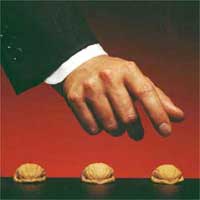
A bowl newly discovered in Alexandria, Egypt, and dated to the period from the late second century BCE to the early first century CE bears an engraving magicians cupthat may be the world’s earliest known reference to Jesus Christ. The engraving reads dia chrstou o goistais, translated by the excavation team as “through Christ the magician.” According to French marine archaeologist Franck Goddio, co-founder of the Oxford Center of Maritime Archaeology, and Egyptologist David Fabre, the phrase could very well be a reference to Jesus Christ, since he was one known as a primary exponent of white magic.

The team found the bowl during their underwater excavation of the ancient harbor of Alexandria. They speculate that a first-century magus may have used the bowl to tell fortunes. They note that the bowl is very similar to one depicted on two early Egyptian statuettes that are thought to show a soothsaying ritual. Ancient soothsaying manuals describe a technique in which the fortune teller poured oil into water and then entered an ecstatic state while studying the whirling mix. In the hallucinatory state, the fortune-teller hoped to meet mystical beings that could field questions about the future. The inscription, the archaeologists theorize, may have served to legitimize the soothsaying by invoking the name of Christ, acknowledged to be a wonder-worker.

How weighty is the evidence?
• Is it "Christ" or "Good"? – The archaeologists may have mistaken one Greek word for another in their interpretation. A glance at the photograph of the cup reveals a letter between the rho ("P") and the sigma ("C"). The letter, though poorly formed, seems unmistakably the letter eta ("H"). If this identification is correct, then the lexical form of the Greek word inscribed is not christos, but chrēstos, meaning "kind, loving, good, merciful."

The prepositional phrase, then, probably indicates that the bowl was a gift, given "through kindness" from some benefactor. It seems obvious that chrēstou is much more likely than christou for the engraved word. Rather than referring to the power of Christ, the word chrēstou might be a reference to the person who gave the cup as a gift—as we might write on a gift “from Donald with best wishes.” This explanation seems as plausible as its alternative is unlikely.

• References to christos too vague to reach certainty – Yet even if christou is the correct word, we are still far from reaching certainty that it is a reference to Jesus Christ. We must remember that the word christos was not a personal name of Jesus but a title, the Greek translation of the Hebrew word mashiach ("Messiah, anointed one"). Like its Hebrew counterpart, this Greek term could apply to any number of people. It occurs in the Hebrew Scriptures more than 60 times, designating priests, prophets, and kings, as well as the anticipated Messiah. It even describes the pagan ruler Cyrus of Persia (Isa. 45:1, LXX). Calling someone christos does not necessarily identify that person with Jesus. Even the Greek Scriptures warn that many would claim that title (Mark 13:21-22).

• The meaning of goistais – In Theological Dictionary of New Testament, Gerhard Delling defines goēs, the lexical form behind goistais, as “imposter, charlatan, one who performs magic through formulae.” Its only New Testament occurrence is in 2 Timothy 3:13: “…evil men and imposters will go from bad to worse, deceiving and being deceived.” Delling says that among ancient people, those who believed in demon possession tended to hold the goēs in high respect, while the educated people tended to look down on such a person. (See also the entry for goēs in the Liddell-Scott-Jones lexicon, which defines it as "sorcerer, wizard" and secondarily as "juggler, cheat.")

If this term goistais, therefore, were a reference to Jesus Christ, it would be most inappropriate. Jesus did not perform miracles through such formulae as abracadabra, alacazam, or presto. When He did speak, he gave simple commands, such as “Be healed!” or “Rise and walk!” Even the words ephphatha and talitha koum of Mark 5:41 and 7:34, respectively, are merely “Be opened!” and “Little girl, I say to you, get up!”, spoken in Aramaic, Jesus’ native tongue. Rather than using formulae, Jesus constantly varied the means by which he healed people—sometimes touching (e.g., Mark 1:31), or saying a few words (e.g., Mark 2:11), or healing without touch (e.g., Matthew 12:13) or even without being present (e.g., Mark 8:13). Some scholars believe He probably varied His healing procedures for the very purpose of avoiding magical associations.

The archaeologists have apparently forced their translation, as if goistais is genitive singular, like chrēstou, and functions in the phrase as an appositive. Goistais, however, is dative plural, making their suggested translation impossible. The phrase dia chrēstou goistais probably means "[Given] through kindness for the magicians."

• The dating is probably too early – At the time of Jesus, tens of centuries before the printing press, and two millennia before the digital age with its instant communication, events in one part of the empire often had little impact beyond the immediate vicinity. For the ripple effect of the ministry of Jesus to reach Alexandria would take some years, and at first would be felt only in Christian and then Jewish circles. For it to sweep across to pagans like the owner of the soothsayer's bowl would take even longer. And not only would the magician have to know of the miraculous power, but enough time would have to elapse for to convince him or her that customers would also be aware of Jesus.

Yet the latest date assigned for the bowl is the early first century. Given that the crucifixion and resurrection of Christ happened no earlier than 30 CE, that only allows 20 years before we reach mid-century. One hundred years or even more might be needed for the ripple to flood the pagan consciousness of Alexandria.

What can we conclude?
If the engraving did refer to Jesus Christ, it would constitute an extrabiblical confirmation that Jesus was a miracle-worker. This is similar to the impact of what is now known as the Paris Magical Papyrus, dated to about 300 CE. It describes an elaborate exorcism ritual, which begins, “I adjure you by the god of the Hebrews,” and then lists a number of mystical names, of which Jesu is the first. The adjuration continues with numerous references to biblical events and persons, some of which are garbled. The point for New Testament studies is the confirmation that in Egypt about 150 years after the resurrection, Jesus was known as a successful exorcist and called “the god of the Hebrews.” This latest discovery would make a similar argument from evidence much, much earlier.

Such evidence opposes against claims skeptics have made for generations that Jesus' miracles all have rationalistic explanations. The eyewitnesses found sufficient proof in Jesus' works to discern the all-powerful hand of God. In the words of the Apostle Peter, Jesus "went around doing good and healing all who were under the power of the devil, because God was with Him" (Acts 10:38). Even if legitimate, this evidence would not constitute proof that Jesus was a magician, despite the claims of such books as Jesus the Magician: Charlatan or Son of God? by Morton Smith, published in 1978. (See Barry Crawford’s largely negative review, published in the Journal of the American Academy of Religion [10/26/1978].)

The problem, however, is that the evidence is too early and that it is too ambiguous to be credible. It seems to be another example of archaeologists attempting to grab headlines by placing their latest discovery in the same sentence with the words “Jesus Christ.” Such unwarranted coupling often contributes to unjustified conclusions about Jesus among the ignorant and the credulous.

NOTE: The Franck Goddio Society has responded to this blog.

Want to Go Deeper?

Recommended for purchase (at discount)

Howard Clark Kee. What Can We Know About Jesus? Cambridge, 1990. – Explores both the biblical accounts of Jesus' life and works and the extrabiblical material touching on this. Extrabiblical references to Christ include the writings of non-orthodox Christians, pagan authors, and Jews. Kee analyzes all the relevant material to determine what precisely can be deduced about Jesus from these diverse accounts, written by both friend and foe.

Craig L. Blomberg. The Historical Reliability of the Gospels. 2nd ed. Inter-Varsity, 2008. – Reveals the faulty analysis and presuppositions that have led to mistaken conclusions about the Gospels, providing scholarly criteria for judging these books and biblical answers to our hard questions. Thoroughly updated in light of new developments. Readers will find that over the past twenty years, the case for the historical trustworthiness of the Gospels has grown vastly stronger.

C. K. Barrett. The New Testament Background. HarperOne, 1989. Contains a discussion of the Paris Magical Papyrus along with its text in English translation (pp. 34ff). Also contains a wealth of other material relevant to New Testament studies.

Recommended for online reading

Details about the Paris Magical Papyrus in G. A. Deissmann, Light from the Ancient East. Hodder & Stoughton, 1910. pp. 254ff.

Gary R. Habermas, The Late Twentieth-Century Resurgence of
Naturalistic Responses to Jesus' Resurrection
. Trinity Journal, 2001.

Larry W. Hurtado, Lord Jesus Christ. Eerdmans, 2005. – A short discussion of the title “Christ” (“Messiah”).

You may want to study the earliest charge that Jesus was a magician, leveled by the anti-Christian debater Celsus in the third century. The church father Origen ably defended the orthodox view by pointing out that in contrast to magicians, Jesus' miracles all had a moral purpose. See Origen, Against Celsus, book 1, chapter 68. In the century before, Justin Martyr anticipated such a charge in his First Apology, chapter 30.

If you are curious about Morton’s Smith’s book, take a look at the exchange Professor Smith had with Frank Kermode over the latter’s review of Smith’s book in the New York Review of Books. This exchange includes a summary of Smith’s main points and the essentials of Kermode’s critique. Be sure to read all four essays, the first two published on Dec. 21, 1978, and the second on Feb. 8, 1979. Unfortunately, the original review is unavailable without a subscription to the Review. Here is a brief review by Terrance Callan from the Library Journal (June 15, 1978).

Steve Singleton, DeeperStudy.com
Subscribe to feed

Labels:

Beware of the Fall

Wednesday, October 01, 2008

I leaned forward and swallowed hard. It wasn't easy to say, "I think God was trying to get your attention," I told her. Patrice whispered, "Maybe so. . . ."

She had fainted while trying to get a good camera angle of a beautiful waterfall near Ithaca, New York. Unconscious, she rolled over the edge and fell 100 feet to the floor of the gorge. Now she was in a body cast with two broken legs, several broken ribs, and a broken back. Also most of her teeth had been knocked out, but she was alive, and doctors expected her to walk out ot the hospital.

Patrice had suffered another fall a couple of years before her tumble into the gorge: a fall from grace. Shortly after her baptism into Christ, she had just stopped coming to church. When urged to come back she replied, "I know I ought to come. Maybe I'll surprise you one of these Sundays." No one could make an X-ray or MRI of the spiritual damage inflicted by that fall; there were no broken bones or knocked-out teeth. But her spiritual life was spurting out like blood from a severe laceration.

Speaking from the experience of his own spiritual nosedive, the Apostle Peter pleads with us, "Be all the more eager to make your calling and election sure. For if you do these things, you will never fall" (2 Peter 1:10). "These things" refers to the ongoing development of the Christian virtues listed in verses 5-7--qualities the Holy Spirit builds into our character as we cooperate with Him. This development process cannot happen to us isolated from the family of God. It takes place through constant interaction and encouragement from fellow Christians.

I wish I could tell you that when Patrice walked out of that hospital, she walked right back into the fellowship of the local church. But it didn't happen. Her temporary resolve to come back to Christ evaporated soon afer she left the hospital. The fractures of her body had healed, but her soul remained shattered and bleeding. She serves as a warning for us: stay away from the edge of the chasm.

Want to Go Deeper?

Despite such reassuring passages as Romans 8:31-39, John 10:27-29, Ephesians 1:13-14, and 1 John 5:11-15, nearly every book of the New Testament warns us of the possibility of falling from grace. Here is a sampling:

Recommended for online reading...
You may be aware of the long-standing debate between Calvinists and Arminians. Here are the arguments on both sides:

Recommended for purchase...

Steve Singleton. Possibility of Apostasy: Those who know the risk climb more carefully – E-book of 42 passages in the Gospels and the rest of the New Testament regarding whether a saved believer can fall from grace. Also provides similar summaries for 11 passages supporting the security of Christians in their salvation. Only $1.

Dale Moody. Apostasy: A Study in the Epistle to the Hebrews & in Baptist History (1991). – Against the prevailing opinion of his own denomination, Moody presents the case for conditional election that takes seriously the warnings of the Epistle to the Hebrews.

J. M. Pinson, ed. Four Views on Eternal Security (2002). – Four scholars present their views and dialogue with their critics. The four views are: Classical Calvinism, Moderate Calvinism, Classical Arminianism, and Wesleyan Arminianism. If you believe in listening to both sides of a controversial issue, this book is for you.


Steve Singleton, DeeperStudy.com
Subscribe to feed

Labels: , , , , , ,

Crown of Life or Crown of Death?

Friday, September 05, 2008
crown wreath discovered

Sensational Discovery
In August 2008, Greek archaeologists discovered a priceless gold wreath in what is regarded as the ancient city of Aigai, the original capital of Macedonia and the place where Philip II, father of Alexander the Great, was assassinated in 336 BCE.

The crown of golden oak leaves was included along with human bones inside a golden cylinder, which itself was secured within a large copper vessel. Archaeologists have assigned its date to the fourth century BCE, at about the time when Philip and Alexander reigned. The excavation lies just outside of modern Verghina, a few miles east-southeast of Verea/Berea and about 320 miles (520 km) north of Athens.

Cultural Background
Such crowns were common in ancient times as symbols of success in a variety of contests, including military conflict, athletic contest, political election, academic achievement, business triumph, or trial at court. Often the crown (Greek: stephanos) was constructed from the leaves of plants such as the oak, olive, laurel, and pine trees, or even celery stalks.

The Christian's Crown
At the close of his life, the Apostle Paul describes what he had accomplished by God's grace: "I have fought the good fight, I have finished the race, I have kept the faith." He confidently adds, "Now there is in store for me the crown of righteousness, which the Lord, the righteous Judge, will award to me on that day-and not only to me, but also to all who have longed for his appearing" (2 Tim. 4:7-8). The "crown of righteousness" is a stephanos.

In the Apocalypse, Jesus Himself urges us, "Be faithful, even to the point of death, and I will give you the crown of life" (Rev. 2:10, again stephanos). In the heavenly throne room vision that follows, the Apostle John reports seeing 24 elders dressed in white wearing golden crowns. Soon each throws down his crown (stephanos) before the One on the throne, apparently symbolizing their dependence on Him for their victory. They confess that as Creator, He is worthy of glory, honor, and power (Rev. 4:4, 10-11). These same elders remain throughout the rest of the prophetic vision as witnesses of God's awesome deeds (see Rev. 5:8, 14; 7:13-17; and 19:4). Later Christ ("the Word of God") is pictured as wearing many crowns (Rev. 19:12), but this word for "crown" is diadema, the circlet of silver or gold worn by royalty.

Our Contest
Like the military conflict, the Christian life is a battle. Sometimes the salvos come at us unexpectedly, all hot and heavy. Sometimes we get wounded from friendly fire. Like the athletic competition, we are running hard and sometimes getting exhausted. The things that make a big difference are training, teamwork, confidence, and persistence. Like the political campaign, our opponent is a determined fighter and slings mud. We suffer innuendo, slander, and gossip.

Like students, we must prepare ourselves if we want to pass the exam. Like the businessperson, we must anticipate the competition and strive to add value to what we offer. Like the defendant, we have to gather the evidence and present our case, relying on the Judge's integrity to render a fair verdict. And when the bell of the final round has rung, when we stand with Paul at the finish line, still holding the baton, we look forward to those words, "Well done!" and to receiving that crown.

We don't expect to go to the grave wearing a wreath of golden oak leaves. Scripture's crown is a crown of life, not of death. What we are hoping for is resurrection to an eternal life in intimate fellowship with the Father, with His Son, and with the Spirit! Our triumph, our victory, our success-it will all be due to the Father's grace, the Son's redemption, and the Spirit's empowerment. After all the trials, when the contest is over and the campaign has wound down, victory at last will be sweet.

Want to Go Deeper?

Take a look at the other passages in the New Testament that describe the stephanos, which the overcomer will receive. They include: 1 Cor. 9:25; Phil. 4:1; 1 Thess. 2:19; James 1:12; and 1 Peter 5:4. All verses in the gospel accounts refer to the crown of thorns Jesus wore on the cross, ironically symbolizing His bloody and agonizing victory.

In another passage, Paul uses the verb form of stephanos to warn that Christians might not be crowned unless they compete according to the rules (2 Tim. 2:5; see also 1 Cor. 9:24, 27). Not everyone who starts out the race crosses the finish line. Many things hinder and sin "so easily entangles." We must "run with perseverance the race marked out for us" (Heb. 12:1). How do these warnings mesh with texts like 1 John 5:13 that reveal that Christians can know they have eternal life?

Recommended for online reading...

Steve Singleton. "The Isthmian Games" (includes some images of stephanoi).

Walter Grundmann, "Stephanos" in Theological Dictionary of the New Testament (7:615-636); see also the condensed version (only some of which is available online).

Recommended for purchase...

Robin Osborne. Archaic and Classical Greek Art (1998).


Steve Singleton, DeeperStudy.com
Subscribe to feed

Labels: , , , ,